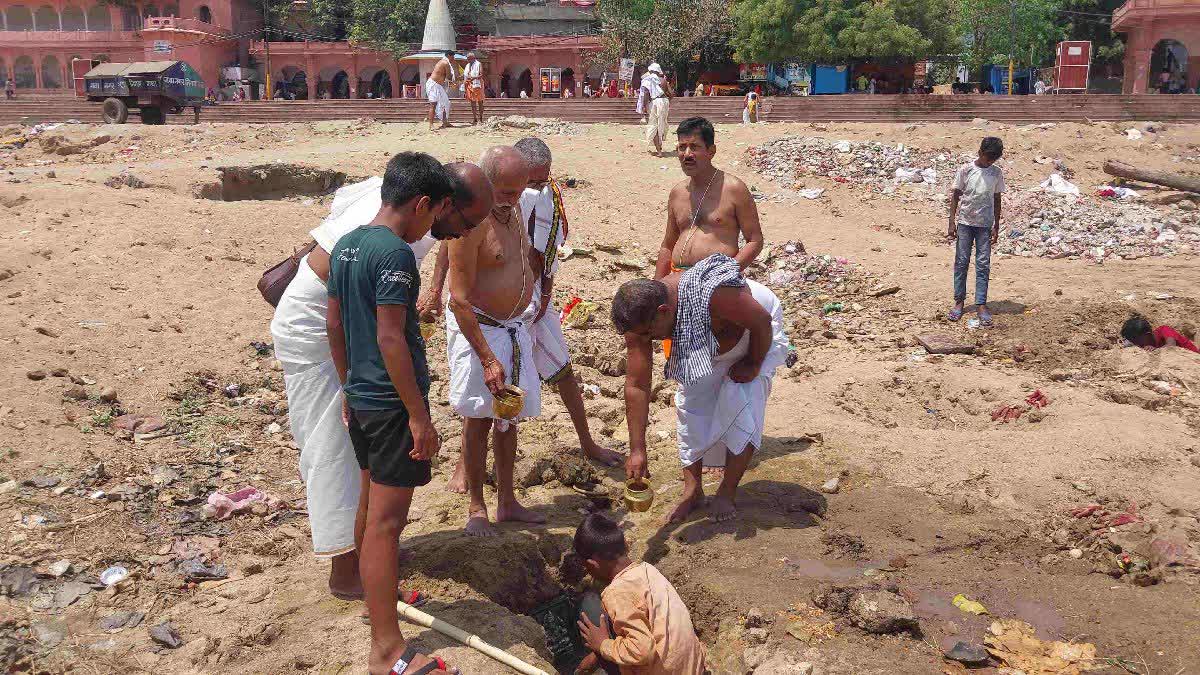
The Phalgu River, flowing through the city of Gaya in Bihar, is an important religious and spiritual site, especially known for Pind Daan. In Hinduism, Pind Daan is a significant ritual performed for the peace and salvation of departed souls. It is believed that performing Pind Daan on the banks of the Phalgu River grants salvation to the souls of ancestors. In this ritual, rice, sesame seeds, and holy water are offered, which are the main elements of the ceremony.
The mythological significance of the Phalgu River is linked to the Ramayana, which gives it recognition as a divine site. It is said that Lord Rama also performed Pind Daan here for his father Dasharatha. According to this legend, when Lord Rama, Sita, and Lakshman reached Gaya during their exile, Rama asked Sita to go to the banks of the Phalgu River for Pind Daan. While performing the ritual, Sita chose a stone as a witness because the Phalgu River was dry at that time. Since then, it is believed that the water of the Phalgu River never dries up, and this stone is still famous as 'Sita Kund'.
The city of Gaya and the Phalgu River are mentioned in many religious scriptures. The Puranas describe the glory of this place, where performing Pind Daan satisfies the souls of ancestors. Scriptures like Vayu Purana, Garuda Purana, and Skanda Purana describe in detail the religious significance of Gaya and the Phalgu River.
Every year during Pitru Paksha, millions of devotees gather on the banks of the Phalgu River and perform Pind Daan for the peace of their ancestors' souls. Pitru Paksha, also known as Shraddha Paksha, is observed during the Krishna Paksha of the Bhadrapada month. This period is considered especially auspicious for Pind Daan and Tarpan. During this time, there is a huge crowd of devotees in Gaya city, and special rituals are organized on the riverbank. People express respect for their families and ancestors and pray for the liberation of their souls.
In the ritual of Pind Daan, rice, sesame seeds, and holy water are offered. Rice and sesame seeds are considered food for the departed souls, while holy water is used for the peace and purification of the soul. Mantras are also chanted during Pind Daan, which help the soul attain salvation. This ritual is a symbol of a person's devotion and dedication and is performed with deep religious feelings.
The Phalgu River is not only important for religious rituals but also symbolizes the spiritual connection between the living and the dead. This river serves as a medium for souls who have left this world and for those who are still alive. Thus, the Phalgu River acts as a bridge between life and death, helping in the attainment of peace and salvation for souls.
Considering the importance of Gaya and the Phalgu River, this area is also significant from a tourism and religious perspective. Devotees and tourists coming here not only come for Pind Daan but also experience the historical and cultural heritage of the place. There are many ancient temples and religious sites in Gaya city, making it an important religious center. Mahabodhi Temple, Vishnupad Temple, and Sita Kund are some of the main attractions of Gaya.
The Mahabodhi Temple, located in Bodh Gaya, is a major pilgrimage site for Buddhism, where Gautama Buddha attained enlightenment under the Bodhi tree. This site is not only important for Buddhists but is also famous as a World Heritage Site. The Vishnupad Temple, situated on the banks of the Phalgu River, is dedicated to Lord Vishnu, and devotees come here to see the footprints of the Lord. This temple is a major site for devotees performing Pind Daan.
Sita Kund, located on the banks of the Phalgu River, is associated with the story of the Ramayana. The mythological story of Sita performing Pind Daan is remembered here, and this place holds special significance for devotees. Devotees coming here bathe in Sita Kund and offer holy water.
Along with the religious and spiritual significance of Gaya and the Phalgu River, the natural beauty here is also captivating. The beauty and tranquility of this city situated on the riverbank provide devotees with a spiritual experience. The natural scenery and religious atmosphere together offer a unique experience.
Understanding the importance of the Phalgu River, the government and local administration are also making special efforts for its development and conservation. Many schemes are being run for the cleanliness of the river and environmental protection, so that devotees and tourists coming here can get a clean and beautiful environment. The development of facilities on the riverbank and the conservation of religious sites are also included as priorities.
Overall, the religious, spiritual, and cultural significance of the Phalgu River and Gaya city is extremely deep and wide. This place is not only important for followers of Hinduism but also provides every visitor with a spiritual and cultural experience. The ritual of Pind Daan on the banks of the Phalgu River is a unique religious act, symbolizing an eternal connection between living and departed souls. Thus, Gaya and the Phalgu River have been an integral part of Indian culture and religion for centuries, and in the times to come, this place will continue to maintain its religious and spiritual significance.